Death After Live: Low End Theory 1

DI boxes. I didn’t like them. I didn’t understand them. I’ve invested in this refrigerator size cab and monster amp spewing forth fuzz and ass-end frequencies. Then, some sound guy comes along and puts a DI box before the amp and cab, negating the EQ on my amp, and cranks fuzz sans bass. Now it still sounds like ass, but not in the good way. Why can’t they just mic it?

Or maybe even Mikey it?

I’ve had this argument against DI boxes and pro mic’ing bass for awhile now, until someone more knowledgeable than I finally asked, “Do you bring your own mic that can actually capture full bass frequencies?” Oh. Hadn’t thought of that. I don’t know shit about mics. I don’t know shit about bass frequencies. I don’t know shit about shit, apparently.

Continue reading “Death After Live: Low End Theory 1”

Another VH – One Four Woe

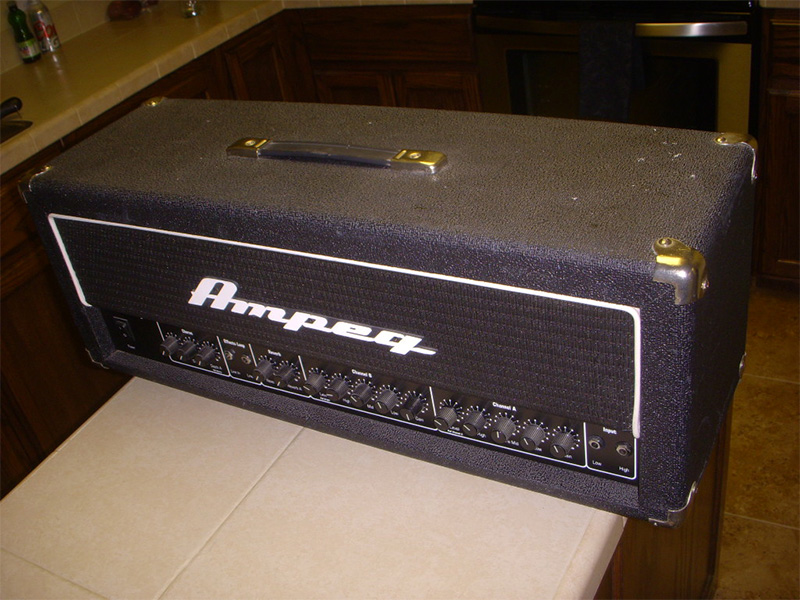
Someone commented that they’d been looking for one of these amps after I posted about the last alteration of mine, but couldn’t find any without “issues.” That seems to ring true here.

Today’s problem; the “high” input jack on my VH-140C that Dan Randall uses with us in The Sean Band. It cut out when the cord was jiggled. After almost 20 years of dedicated 1/4″ plug holding, the PCB mounted jack was failing to hold the 1/4″ plug tightly. It needed replacing.

First off, the high input and low input are confusing. Different manufactuers, including Ampeg, use different terms for dual inputs like this. With this amp, “high” is for more gain / sustain and guitars with passive pick ups. “Low” lessens the input and is for more cleans and guitars with active pick ups. I always thought it would be opposite. In this case, the high input ain’t working, so less is more. Less-on over. Les Nessman.

I don’t like these PCB mounted jacks because the metal contacts always wear out in the same way and cannot be bent back into shape. In the age of machines manufacturing machines, however, they are ubiquitous, like Hunter-Killers and Terminators. Unfortunately, their styles are not.

Upon opening the amp, I found this jack. It looks like a standard Cliff brand PCB jack, but it has L shaped legs for the PCB mount. A kind with straight legs will not fit correctly through the faceplate of this amp. That’s fine, but I can’t find anyone that sells these! They do exist on the website of the manufacturer, CHK Electronics, but they don’t sell from their site. They have yet to respond to my email about where to acquire ’em. Fuck. (update: They totally responded a few days later and even offered to sell me a “small” amount… still waiting on the purchase, but go CHK for an actual customer service response! That’s better than Ampeg can say.)

Luckily, the effects loop on the front of this amp uses the same jacks, and Dan doesn’t use the effects loop. He doesn’t use effects, because he has two left feet. Literally… it’s quite freakish.

Some desoldering, a quick swap, and the amp inputs are working fine. If I ever decided to sell this amp, it’s very unlikely they’ll test the effects loop. Shhhhh…

UPDATE 2-8-2012: The amp continued to have problems, cutting treble in and out… eventually, after I tried bypassing the effects loop with a cord, I found the moved problem jacks were still causing problems. I eventually ordered the S4-1308 replacement jacks from Cliff USA and so far, so good. So what.

Pedal Bored

I went for years and years playing bass without this toy obsession… music gear. I started playing bass through an old Ampeg SS150 guitar head. I really didn’t know any better, or how to play bass. I still don’t. Eventually I graduated to a real bass head. I picked up a couple BOSS pedals, the ODB3 and the TU2. Pretty standard for someone no more interested in their gear than that it makes some noise.

Honestly, I was too busy spending money collecting Star Wars toys to be bothered with gear. Now I hate Star Wars.

It took me more than a decade to organize, but eventually I picked up a proprietary BOSS pedal cases. You know, the ones designed to hold pieces of disposable crap from Taiwan. It’s basically a garbage bag, but it served me for a number of years.

There was an attempt to modify that plastic piece of shit pedal case from BOSS to fit a few other things. That was a non-starter from the get go, considering the things I’ve added to my set up. It’s not called a Big Muff because of it’s petite size. Then I watched the boys from Wolves in the Throne Room on tour as they lugged giant SKB pedal cases and had to check them when flying because of their size. With luggage prices ever increasing, this solution did not fly. <-- sweet pun. I decided to DIY a pedal board and case. As a registered basshole, I have more pedals than I ever need to play songs about eating poo. To exceed excess, I limited my board to what I could fit in a standard briefcase. If you have more than that on stage at your feet, you’ve likely got a small dick. Or an enlarged clitoris. Or you’re a bassist overcompensating.

I picked up a good, sturdy, used briefcase from local salvage store, Urban Ore. Urban Ore is an amazing place full of tons of old shit, with just a hint of cat piss in the air. Almost all the props in Impaled’s “Preservation of Death” video were cobbled together from crap there. After throwing around and stomping on the case, I found it was a good fit and would protect my precious cargo. I could easily take it on a plane as a carry-on. Never mind all those wires and metal boxes, Mr. Homeland Security.

I took measurements and made some mock ups of a pedal board with cardboard to make something I could pull in and out of the briefcase easily. It came out to 16.5×11.75″. After further experience picking up a few other briefcases that my board fits into, this seems to be close to a standard fit.

Then the board itself: I couldn’t mold plastic. I tried a thin wood one, but it felt too weak. I thought about strength and machismo, which defines me to a tee, and I came up with diamond plate. You know, that chrome metal shit all over tool boxes and semis and usually surrounded by men with guts (not bravado, the tummy kind). They sell diamond plate metal sheets at Home Depot, but the price is a bit high. A little research, and I found Alco Iron and Metal. They’re a huge metal shop (not music, the ferrous kind) just south of Oakland in San Leandro. They had scraps of diamond plate that they let me have for a good price.

I cut the metal down to size using a jigsaw and a Bosch brand blade made to cut metal (U118G). Nothing more special needed than that, even with the thick grade I picked that wouldn’t bend underfoot. I also sanded the corners to be rounded.

It took some elbow grease, patience, and lot of WD40 going to keep the blade slick. I also used liberal amounts of WD40 when drilling holes (a must to keep your bits sharp) for a handle I decided to put on the pedal board. It’s a cabinet handle also acquired from Urban Ore. I initially thought I’d put two on the sides of the board. After experimenting with the briefcase and some pedals, I ended up with just one handle on the end of the board. It would be easier to pull out of the briefcase and leave more space for the pedals.

On the side for the bolts, I bored out a cavity for the heads of the bolts with a larger drill bit. This way, my board would lie flat on the ground.

I realized that this was a gigantic metal plate I was going to be placing on stages surrounded by electricity. I bought a sheet of rubber used to line tool boxes from Orchard Supply Hardware and cut it to fit my board. Using a huge amount of two part epoxy well mixed, I affixed the rubber to the bottom of my pedal board. Now, it wouldn’t slip and was safe from grounding out against any loose current. I’m not fond of dying.

I’ve tried to come up with many different solutions for how to secure a pedal to a board… I’ve failed. There is no better way than Velcro. Thank you space program for making sure my pedals don’t move around and that I don’t have to tie my laces. I got “industrial strength” Velcro brand strips from Michael’s Arts and Crafts Store. This stuff is so strong, it holds to itself better than the sticky backing holds to the pedals if I lift them off. One could probably do with standard Velcro. I decided to just do a few strips. I want to see that diamond plating because it’s hella manly. The board fits in the briefcase perfect and pulls out easy. 
Then comes the fun part… populating the board. This set up has changed several times since I made this pedal board, but this is current. It’s like a really expensive game of Tetris. All the pedals are wired for power from a single Visual Sounds One Spot and can stay connected with George L patch cables

The board and pedals, nestled in their new panic room, are safer than when they were floating around and are easily accessed for a quick set up. 
As an added bonus, the brief case had extra pockets on top that fit my two 20′ instrument cables. Organized, just like the business man I was never smart enough to become. 
My final touch is the mark of the G.O.R.E. Corps, the Rxxx. Partially out of vanity, partially so it doesn’t get lost in a dark corner and left behind after a show. I mean, if I lost that phaser, wah, and delay, could the show go on? COULD IT? 

It’s enough to chill the soul.

Doktor Ross Sewage
www.doktorsewage.com

Grabber music: Drum Mic Mount

Dino used to do some vocals in Ghoul. He’d also done vocals for his previous bands, Asunder and Dystopia. It’s rare to find drummers who can also vocalize, and rarer that they aren’t ugly like Jimmy Marino of the Romantics. Well, one outta two ain’t bad. Dino can growl with the best of them while playing drums, and he wasn’t doing it anymore. I really wanted him back to singing on our upcoming tour.

Now if only we could get him to stop talking

At least one reason he gave up was the mic stand. For years, Dino had to have a big ass boom stand, balanced with the arm stretched all the way out, and placed oddly somewhere amongst his jungle of cymbal stands. This just doesn’t make sense and it’s a pain in the ass to set up. I’ve seen it lots of other times with other drummers mucking shit up and the mic flailing about.

Continue reading “Grabber music: Drum Mic Mount”

VH-140C Power jack fix

For our band, heretofore referred to as “Sean’s Band,” our guitarist Dan Randall uses my Ampeg VH-140C guitar head. He’s had a string of bad luck getting his own taken care of. My VH-140C is a great head I inherited from Impaled’s old guitarist, Leon del Muerte. It’s solid state and goes for cheap used, but makes the perfect compressed chugga chugga. That makes it the amp of choice for us, Pig Destroyer, Dying Fetus, Misery Index, and more. Leon left it behind, broken. I got it fixed and now it works again… sorta.

vh140c

Dan kept saying it was cutting out. I didn’t believe him, until I saw the distortion light blink out and come back while he was doing nothing. On a cursory inspection, I noticed the power jack did not seem tightly affixed on the back of the amp. Was it shaking out? It probably didn’t help we kept it on top of my bass rig.

Continue reading “VH-140C Power jack fix”

Building a better Rat trap

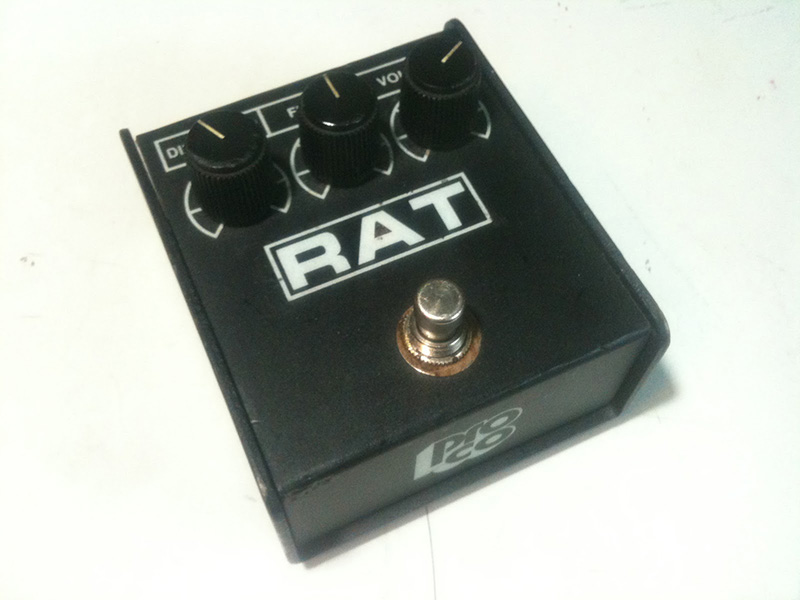
The ProCo Rat is a legendary pedal. It was designed by ProCo engineer Scott Burnham in 1978 in an attempt to build a better mouse trap, so to speak, compared to the pedals they were modding for customers. With some finesse, it can be dialed in as a fuzz, distortion or overdrive. It has a relatively simple distortion circuit built around a single LM308 opamp, itself now a coveted IC chip. It’s the tone on Metallica’s “Kill ’em All.” Legend has it two in a row were used for Carcass’s “Reek of Putrefaction.” Kurt Cobain, Thurston Moore, Kevin Shields, and Jeff Beck are all listed users (info from the always infallible Wikipedia). With the Rat2 in 1988, ProCo innovated again by adding what’s known as the Rat bypass, allowing true-bypass with a power indicating LED.

ProCo Rat 2

So what’s with the fucking battery cover? It sucks. Any time I see these pedals, the battery cover is long gone and the bottom is covered in icky duct tape leaving gummy residue all over the black box. The first one I got, a Rat2, was the same. Liberal amounts of Goo Gone were applied to clean the bastard. My friend gave me an original ’84 Rat. Again, no battery cover. All my friends with Rats? Duct taped battery covers.

Continue reading “Building a better Rat trap”

Lofty ideas #1

Impaled has managed to stay in the same practice place for about 14 years. Holy fuck, has it been that long? Jesus Christo, I don’t think the world asked for a teenaged Impaled. Zit faced and sullen, we have more attitude than ever.

Our space is in what it locally known as “The Old Soundwave,” in that there was a “new Soundwave” started by the original owner, the legendary Al Lucchesi, with some partners. He ditched that and now he just focuses on the original Soundwave. It’s still the old one, and we’re the oldest tenants there. You can read a good article about Al here from the Easy Bay Express. The place has hosted in it’s halls Neurosis, High on Fire, Forbidden, Exodus, Testament, Faith No More, and countless others.

photo by Tony U., from Yelp.com

In this humble space, we’ve written all our records, recorded a couple, filmed two music videos (parts of a third), and shared our space with the likes of Blown to Bits, Morbosidad, Stormcrow, and Worm Ouroboros. So, why, oh why, did it take us more than a decade to decide to build a loft? Fucking morons.

Sean and I enlisted the help of our dear friend and sometime gore collaborator, Scott Bryan. We set to work to build a loft. Finally. We moved most of our equipment into a space that was temporarily empty, much to our benefit. To keep things easy and do it all in a day, we decided to go with it being 8′ tall, because that’s the height that 4×4 wood lumber comes in. That’s just less cutting to do, and it’s a good height to roll full stacks out from under.

Our room is at a slight angle, but basically the width is around 14′. At first, Scott was insistent that we had to put a beam right in the middle of the loft for support. I really didn’t want to. Then a neighbor came by and suggested we really didn’t have to. Instead of just using four 2x4s for the base of the loft, we should use at least one 2×12 for the front. That’s one super thick chunk of board that was terribly unlikely to bend. That’s when Scott remembered, that for once, he didn’t have to build something to code. I mean, who would it hurt to try? Just Impaled.

We were lucky enough to have one back wall made of thick gypsum, or something… I don’t know. It’s a really tough wall to even put pushpins in, so we assumed it would be good. Point is, we were lucky to not have to use drywall anchors. We put up a long 2×4 as our starting base. Of course, we kept it all level as we could. A good device that I was unfamiliar with, not being a carpenter, was a chalk line. Basically, it’s a string you pull tight from one end to another and snap it… and you get a straight line anywhere, drawn in chalk. That was way easier than trying to find a ruler 14′ long.

From there, we attached the side panels. We made these 4′ long, because the plywood sheets we got were 8×4′, and I wanted to do as little cutting as possible. I’m lazy.

Finally the massive 2×12 board was attached. It was a pain to even get in our room, bending around the hallway and the gear that was already in the room.

For the joists, the supports for the ply, we used joist anchors on the back beam and then screwed right into them from the front. The anchors made it a lot easier for us. We didn’t have to try and make the frame and THEN attach it to the wall. The joists were spaced about 2′ apart, because Scott told us this was standard. Hell if I know, I just know it all worked.

Next, we screwed in the 4×4 posts on each corner. Really, this thing was free hanging just fine, but I figured the posts would add a psychological comfort to the drummers who had to sit underneath this monstrosity. Finally, we put up two sheets of plywood, with a slight cut in one of them to match our angled wall. This thing was as solid as a poop after mac ‘n’ cheese.

There was some bitching by the drummers about sound, so I padded the corners and under the plywood (in between each joist) with foam. That seemed to solve the problem, and now everyone is happy we have less shit all over the floor. You can imagine, after 14 years, we’ve gathered a lot of shit.

The materials cost us somewhere around $100. Priceless, when I think of how it made our space infinitely more comfortable. On top of that, it only took a day. Nice. Scott Bryan is our man. He can be contacted by any other Bay Area bands looking for a good guy for a cheap price to help them build a loft at mistermeat138@yahoo.com. Or, get off your lazy ass and give it a go yourself. You can build a small one, a big one, but if you hurt yourself, I’m gonna 1. laugh, and 2. tell you right now that I told you not to without the help of a parent or guardian.

Oh yeah… don’t forget to decorate when you get chance with stripper rope lights. It makes your music sexier.

Doktor Ross Sewage
Minister vom Drek
www.doktorsewage.com

Tuna Footswitch

I bought my SVT2 Pro from my friend Janis sometime in the late nineties for about $800. I really had no idea what it was, just that it said Ampeg like all the other bass players had and that it was very, very heavy. It must be good, because it weighs a lot, and was dubbed by Incantation as “the fucking brick” on Impaled’s tour with them in 2000. It had been on tour with Janis while she played in Stone Fox and L7. I guessed it was pretty good, but I was still too busy trying to learn to play and keep up with my bandmates who’d all been playing years longer than I to actually read about my purchase.


After a love / hate relationship with constant amp breakdowns for a decade, I finally figured out the SVT2 Pro had a vent on the side. I also figured out Ohms, and that I’d been abusing this poor thing for years with incorrect speaker hook ups. Sometimes, realizing my stupidity overwhelms me.

Continue reading “Tuna Footswitch”