
Mic Hunt: Shure SM7B

I have an Amazon Wish List a mile long. They’re dreamy items because I dream of having disposable income to spend on them. Maybe some dreamy billionaire who reads my blog will think I deserve a present. On Christmas Day, my brother surprised me with what he dubbed a “baller gift” from said list. He’s had a good financial year, so he gifted accordingly with a Shure SM7B. Fuck to the yeah.
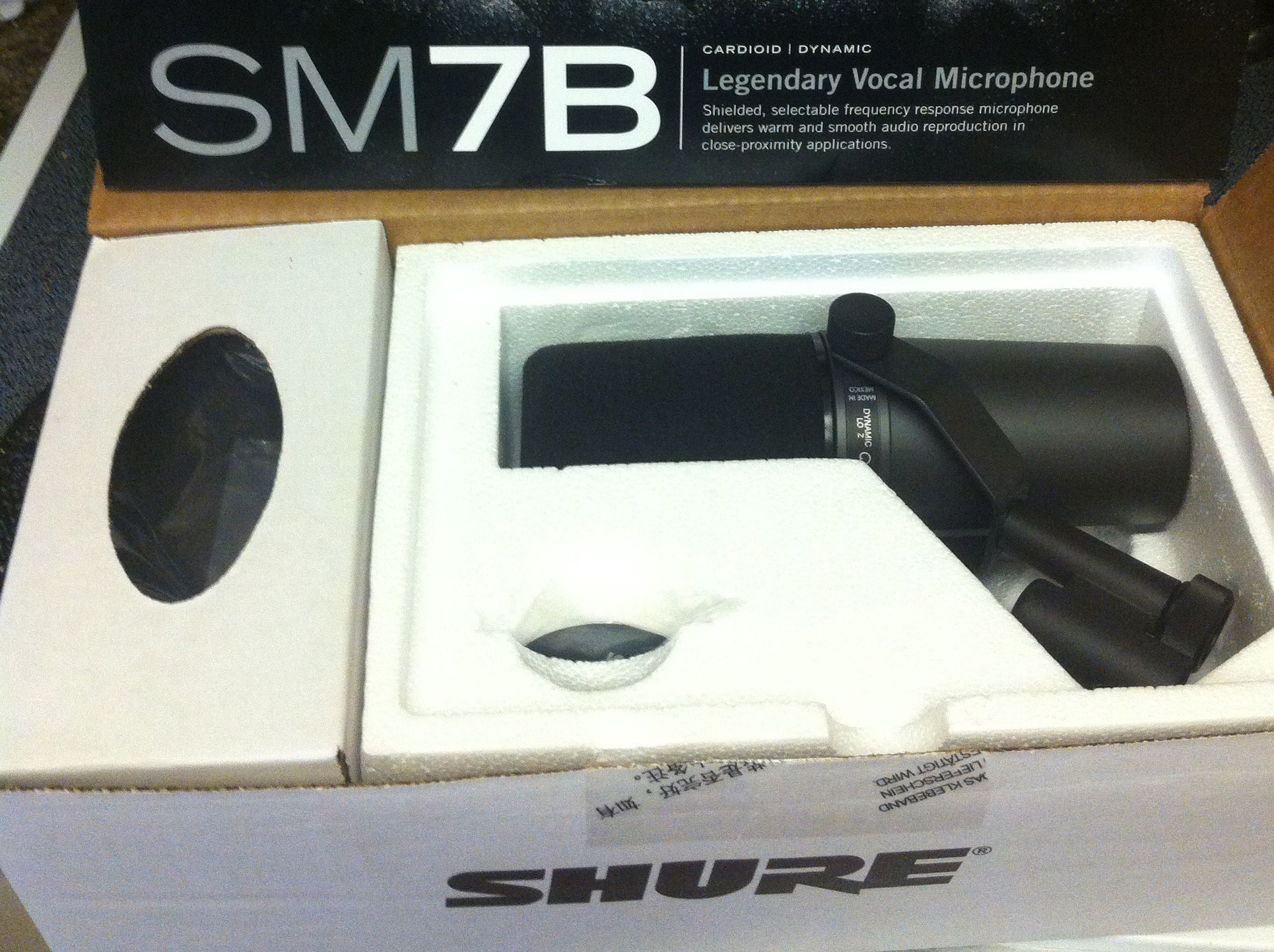
IMG_1584a
I’m even more excited to play with the box.

I don’t own much in the way of equipment that’s not been used. Like, almost nothing. It’s a big deal for me to get something like this without a hunt on craigslist. I’ve wanted a really good vocal mic for some time and the Shure SM7B fit the bill. If it’s good enough for Michael Jackson, then it’s good enough for me. That same logic is how I also got addicted to prescription drugs and why I’m always trying to hang out with Macaulay Culkin.
Continue reading “Mic Hunt: Shure SM7B”

Operating Theater: Gallien-Krueger 400RG

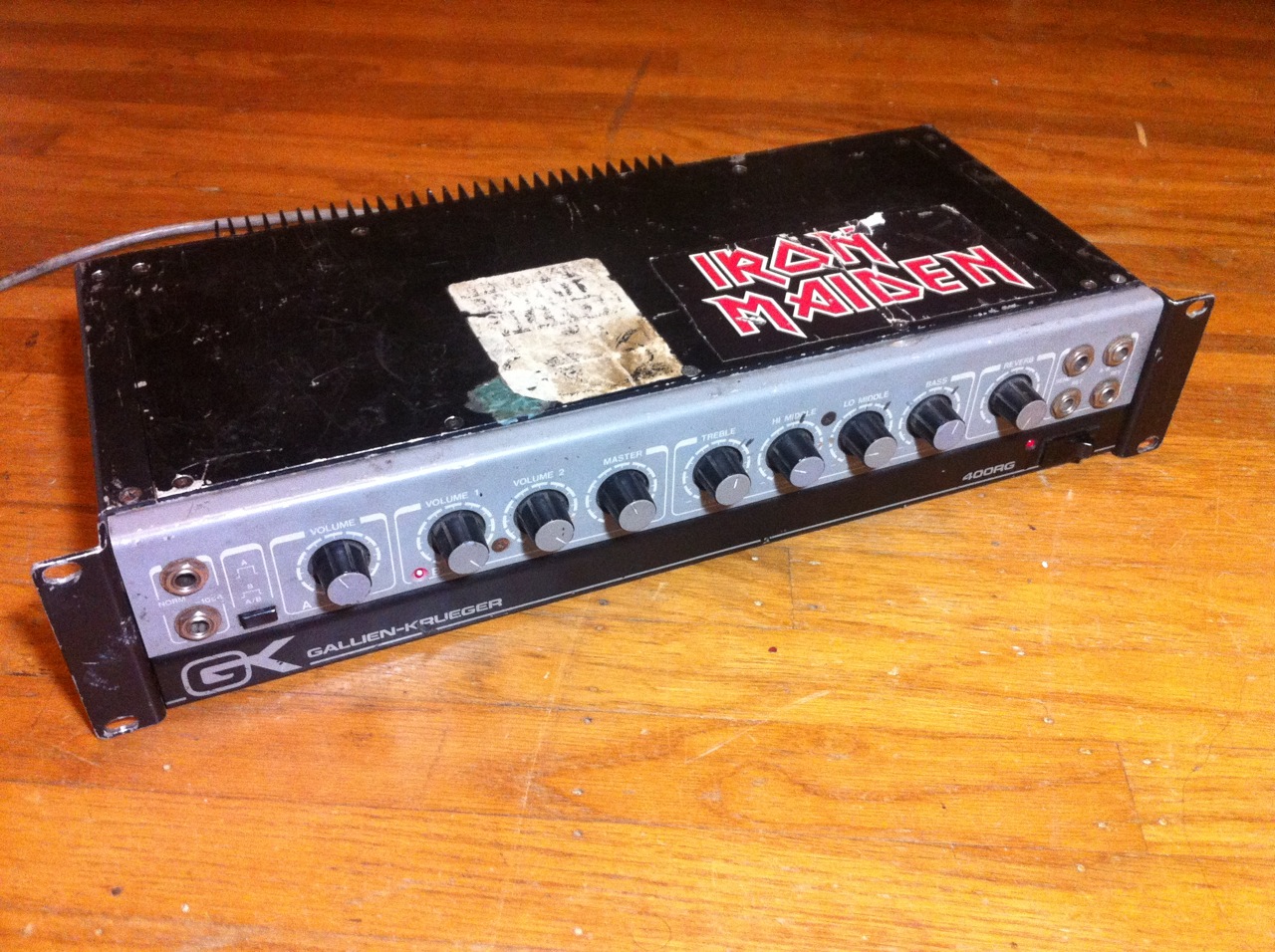
Mauz from Kicker had this interesting paperweight laying around the shop for awhile over at Monolith Press, where I work my day job. Turns out, it used to make noise. This was a remnant of the eighties, a Gallien-Krueger GK 400RG in all its solid-state and rack-mountable glory. It had its own crusty history as the amp for Geoff Evans from Skaven followed by Mauz when he recorded guitar for Dystopia’s “The Aftermath.” It also had a history of blowing up and some questionable, tweaky repairs with non-spec parts.

IMG_2092
So crusty, it has a P.E.T.A. sticker certifying that it’s vegan and better than you.

Mauz asked if I would take a looksy, so it went from a paperweight at the shop to a paperweight in my room. I wasn’t jumping at the chance to work on it. Fixing solid-state amps is a bitch. There’s so many little things that could be wrong or blown and you can’t always see it. You actually have to be smart… or you can blindly test everything a gazillion times until you get it right. So, yeah, testing everything it is.

Continue reading “Operating Theater: Gallien-Krueger 400RG”

Logarithmic Fades, Linearly Speaking

I had a very frustrating conversation the other day about a fade out on a song. I thought it sounded too fast. To me, it sounded very linear. I was trying to explain it should be a logarithmic fade out. Sarcastically, I was told I should teach a class on the subject if I flippin’ knew so much. So fuck it, class is in session. When speaking about audio, what does one mean when using the terms “linear” and “logarithmic?”

linear_v_logarithm
Nothing draws readers in like math!

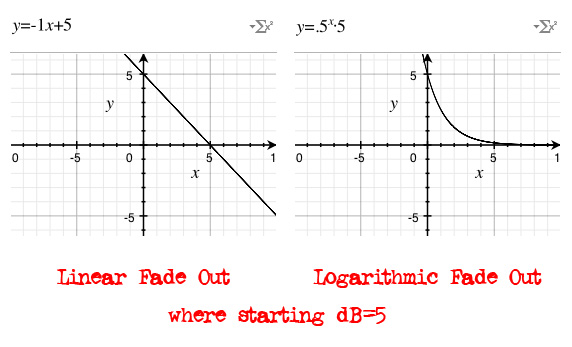
For a linear fade out, a linear equation of the dB decrease could be shown simply as y=e*x+dB, where e is a negative number. That’s a straight line heading downward. When speaking about “logarithms” in audio applications, though, it’s actually describing several things: exponential and logarithmic curves, and their reverse functions. For a “logarithmic” fade out, the function would be y=ex*dB, where e is a number between 0 and 1; that is an exponential function showing decay. For fade ups, the function can be reversed to y=ex/dB to show an exponential increase in volume. Fucking confused, yet? YES!*

Continue reading “Logarithmic Fades, Linearly Speaking”